Great Hunts in Monster Hunter Wilds are where the endgame stops whispering and starts shouting. The first time I opened the Environment Overview and saw two monsters pinned to a single investigation, my stomach dropped like a stone into a flooded mine. This is not a simple two-for-one deal; it is a pressure cooker with a shorter fuse. But if you prepare correctly, that pressure can turn raw hunts into a steady stream of Decorations, jewels, and armor upgrades.
I view Great Hunts as the endgame's double-edged weather vane: they point toward the richest rewards, but the wind they ride can spin you around if you are not careful. After finishing the main story and reaching High Rank, I began noticing these dual-target investigations scattered across the five biomes. At first they looked like rare accidents, like seeing two eagles fighting over the same thermal current. Eventually I learned they are a structured path to some of the best loot in the game.
Unlocking Great Hunts is not immediate. You need to reach Hunter Rank 31 and complete a specific optional quest in each biome. The game quietly locks the system behind five gatekeeper quests, one for each region, and every one of those quests asks you to hunt two Tempered Monsters at the same time. These quests are accepted only after HR 31, so before that point the Environment Overview may show ordinary single-target investigations but never these double-feature hunts. I spent several hours grinding through side missions just to flip those switches, and it felt like priming five separate pumps before the well could deliver water.
| Biome | Unlock Quest Type | Target Combo |
|---|---|---|
| Windward Plains | High Rank optional quest | Two Tempered Monsters |
| Scarlet Forest | High Rank optional quest | Two Tempered Monsters |
| Oilwell Basin | High Rank optional quest | Two Tempered Monsters |
| Iceshard Cliffs | High Rank optional quest | Two Tempered Monsters |
| Ruins of Wyveria | High Rank optional quest | Two Tempered Monsters |
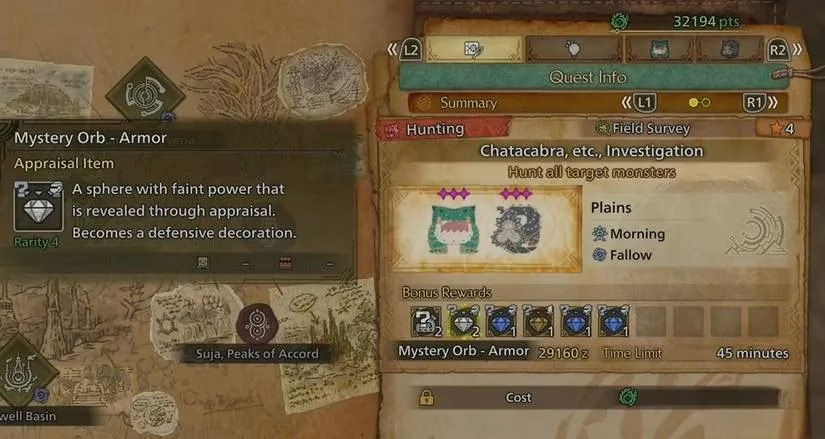
Once I had all five unlocked, I started checking the Environment Overview constantly. The screen became my reconnaissance kite, lifting me above the map to see roaming monsters, weather, and active investigations. When a Great Hunt appears, it shows two monster icons tethered to the same quest. You can click on it and launch immediately, or you can save the investigation for later. Saving is important because Great Hunts are not endlessly repeatable from the same roll. Each saved investigation can be repeated up to three times, which means three sets of rewards, three chances at rare Decorations, and three opportunities to share the hunt with friends. If you save it and later decide to run it in multiplayer, you can do so as long as the investigation remains in your available list. That small ability to bank a double-monster investigation feels like bottling a storm front and opening it when your team is ready.
The rewards are the main reason to chase these hunts. Because you are dealing with two monsters, the end-of-quest reward boxes multiply, and Tempered monsters bring better odds for Decorations and high-tier materials. Capturing or slaying both targets works; the quest does not care how you finish as long as both monsters are dealt with. I prefer capturing when possible because it shortens the hunt and sometimes feels more controlled, but if a monster is too aggressive or low on time, slaying is the safer cleanup. Either way, you should bring traps, tranq bombs, and enough healing items to survive two monsters cycling through the same area.
There is a real risk, though. Great Hunts often have shorter time limits and fewer cart allowances than normal quests. The game is essentially asking you to manage two overlapping threat patterns without tripping over your own weapon. Fighting two tempered monsters at once can feel less like a hunt and more like trying to conduct a thunderstorm with a kite in each hand: one wrong move and the whole sky collapses. Because of that, I always check the monster matchups before accepting. Some combinations are manageable, like a brute wyvern paired with a slower leviathan, while others pair two hyper-aggressive monsters that refuse to separate. I usually bring Dung Pods or use the environment to force one monster out of the zone when the fight becomes too crowded.
One tip that saved me repeatedly: use the Seikret mount to reposition between the two targets. When both monsters occupy the same area, staying mounted lets you move through the chaos without committing to a long attack animation. I also set up camp nearby and restock after the first monster falls. The second monster does not wait, and entering that final phase with empty potions is like walking into a forge wearing paper sleeves—you are asking to get burned.
By 2026, the meta around Great Hunts has settled into a rhythm. Players use the Environment Overview to scout, save the best pairings, repeat them three times, and then move to the next biome. The five biome-specific optional quests remain the key that opens the entire system, so do not ignore them if you plan to farm endgame gear efficiently.
Overall, Great Hunts are not just a way to fight two monsters at once. They are the endgame's amplifier, turning the game's usual reward loop into a louder, sharper, more demanding version of itself. Once you learn to read the Environment Overview and save multi-monster investigations, you stop seeing them as danger and start seeing them as opportunity.