The savannahs of the Windward Plains still echo with the thunderous roars of Rey Dau, and the Oilwell Basin continues to bubble with the molten fury of Nu Udra, but away from the hunt, a different kind of milestone has been reached. By the close of March 2025, Monster Hunter Wilds had cemented its place not only as a spiritual successor to the beloved franchise but as a commercial juggernaut, shattering internal records and selling over ten million copies globally in under a month. The action role-playing title, unleashed on February 28, 2025, across PlayStation 5, Xbox Series X|S, and PC, accomplished what many open-world adventures only dream of—it turned monumental anticipation into an even more monumental reality. But what exactly drew so many hunters, both seasoned and greenhorn, into the Forbidden Lands?
The answer lies as much in legacy as in innovation. The Monster Hunter series had long cultivated a reputation for steep learning curves and intricate combat, yet Monster Hunter Wilds dared to smooth the path without sacrificing depth. The introduction of the Seikret mount allowed players to maneuver through sprawling ecosystems with fluid grace, auto-navigating toward marked objectives and letting hunters sharpen weapons or quaff potions without breaking stride. Meanwhile, the groundbreaking ability to swap between two weapon types mid-hunt—say, executing a punishing Great Sword combo before switching to an Insect Glaive to mount an escaping beast—transformed tactical possibilities. Crossplay, a first for the series, dismantled the walls between platforms, letting a PS5 hunter seamlessly join forces with a PC lancer to topple towering leviathans. These smart touches turned what could have been a daunting trek into an exhilarating journey, and the sales figures seemed to echo the sentiment: in just seventy-two hours after launch, Capcom\u2019s fastest-selling title of all time had already moved eight million units.
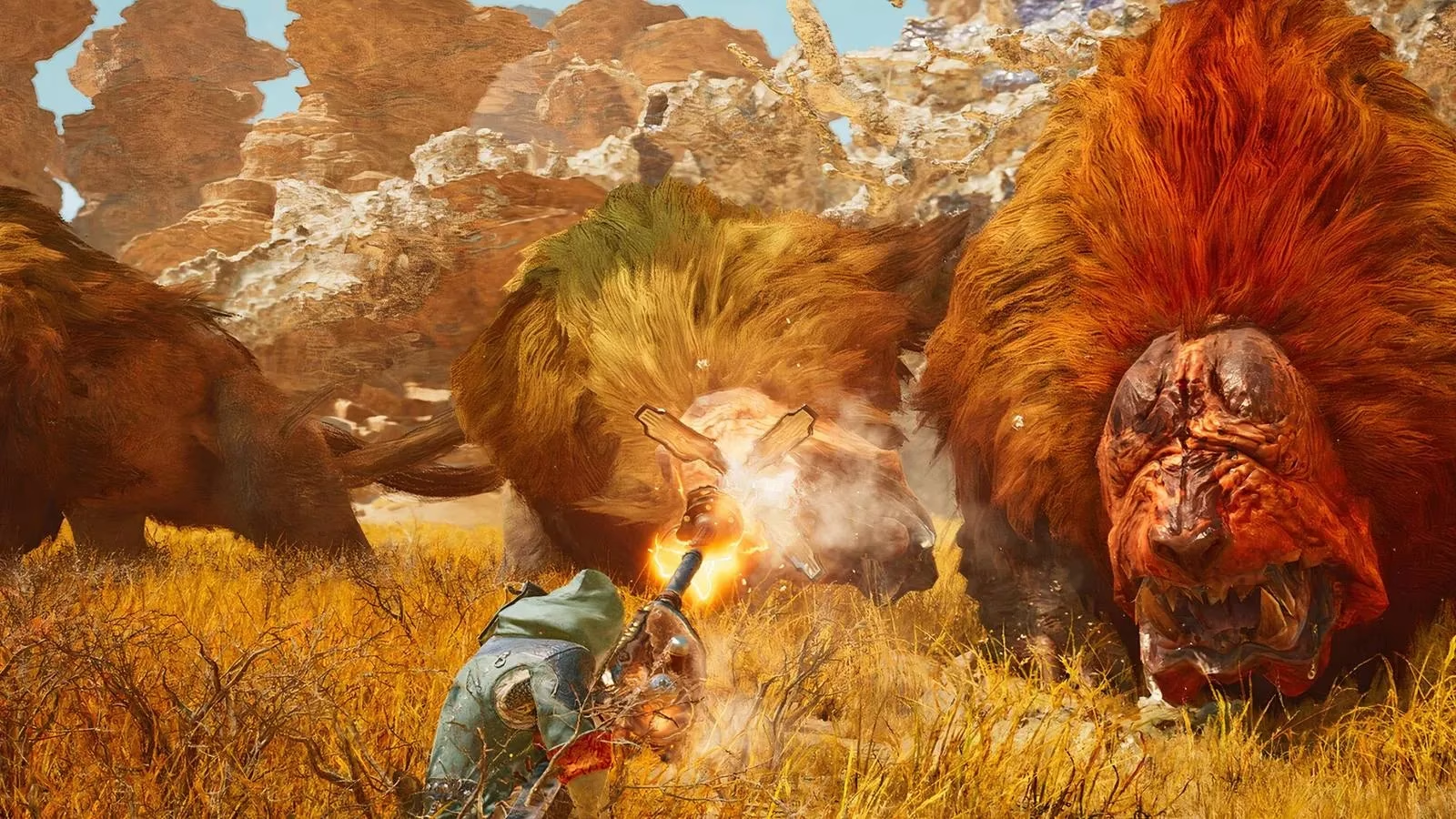
Yet triumph rarely arrives without turbulence. On Steam, the game\u2019s reception had been divided, settling at a \u201cMixed\u201d rating as players wrestled with graphical glitches, performance hiccups, and optimization issues that dulled the sheen of its sprawling environments. Despite these technical stumbles, the game\u2019s all-time concurrent player peak soared past 1.3 million, a testament to a community whose passion could not be dampened by frame drops or texture pop-ins. How does a title with such vocal criticism maintain such staggering momentum? The answer may be found in Capcom\u2019s transparency and the irresistible rhythm of the hunt itself. From the very first weeks, the studio acknowledged the feedback and began rolling out patches while simultaneously teasing a content roadmap that promised to keep the ecosystem alive and evolving.
April 4, 2025, marked the arrival of the first free title update, a drop that introduced a new multiplayer gathering hub where hunters could socialize, arm-wrestle, and queue for quests in a communal space that evoked the cozier corners of previous entries. Adjustments and quality-of-life enhancements accompanied fresh monsters, but Capcom\u2019s announcements that spring made it clear this was merely an opening salvo. The hunt was about to intensify. At the end of April, the dreaded Arch-Tempered monsters emerged—hyper-lethal variants of already formidable Tempered beasts—kicking off a limited-time event that tested the mettle and coordination of even the most veteran squads.
The summer of 2025 saw a second free title update, and with it came a new apex predator rotation that elevated the core experience. Gore Magala, the viral black dragon whose Frenzy Virus had haunted hunters since Monster Hunter 4, slithered into the Forbidden Lands, its shimmering wings and blindness belying a devastating aggression. The locale monarchs—Rey Dau of the Windward Plains, Uth Duna of the Scarlet Forest, Nu Udra of the Oilwell Basin, and Jin Dahaad of the Iceshard Cliffs—received thorough adjustments to their health pools, resistances, and attack patterns, making each encounter a more grueling but rewarding test of skill. Suddenly, missions that hunters had once cleared in minutes demanded flawless positioning, precise item usage, and true teamwork. Is it any wonder that older players found renewed excitement, while newcomers were challenged to climb an even steeper ridge of mastery?
Capcom\u2019s strategy, unveiled in the wake of the ten-million sales celebration, revealed a commitment to long-term engagement that mirrored the life cycles of the very ecosystems players were exploring. Additional Tempered monsters and Arch-Tempered rotations were scheduled well into the latter half of 2025, and rumors of a massive expansion—akin to the Iceborne treatment given to Monster Hunter World—began to circulate in the community. Through official channels, the developer also stressed its attention to weapon balance, hinting at upcoming tweaks to underutilized weapon types and adjustments to overpowered builds that had begun to dominate speed-run leaderboards. Quality-of-life improvements, from loadout management to user interface refinements, continued to roll out in incremental updates, reflecting a studio that was listening as much as it was innovating.
By early 2026, the landscape surrounding Monster Hunter Wilds had transformed. The title was no longer merely a blockbuster launch; it had become a living platform, a sprawling world that breathed with the same vitality as its inhabitants. Player counts remained robust, supported by seasonal events, collaboration quests with other Capcom properties, and a steady influx of layered armor sets that fueled the fashion-hunting endgame. The initial technical woes had largely been ironed out through numerous patches, and the \u201cMixed\u201d Steam rating had slowly shifted toward a more positive consensus as new reviews reflected the improved experience. For every grumble about an overly aggressive hitbox or a frustrating material drop rate, there were dozens of hunters who could recount the electric thrill of a perfectly timed Offset Attack against a charging Tigrex, or the shared relief of severing Jin Dahaad\u2019s tail moments before a triple cart.
The sales milestone of ten million, astonishing as it was in the game\u2019s infancy, now served as a historical marker—a testament to the near-instantaneous resonance of Capcom\u2019s vision. Yet the journey from that snowy February midnight to the present day illustrated a broader truth about modern gaming: launch is only the beginning. With new monsters still on the horizon and a community as ravenous as a hungry Deviljho, Monster Hunter Wilds had woven itself into the cultural fabric of cooperative action games. Players who had once hesitantly stepped off the boat at the Base Camp now stood as seasoned elders, eager to face whatever Arch-Tempered nightmare lurked in the next update. The Forbidden Lands, it seems, would not be left undisturbed for many years to come.