When the grand horns of Suja echo through the Peaks and a hunter steps onto the polished stone of the new Grand Hub, there’s no mistaking the shift in atmosphere. 2026 has brought with it a full refresh to Monster Hunter Wilds, and at the heart of it lies a crucible that flips the core hunting fantasy on its head. Instead of stalking a Rathalos through ancient forests or chasing a fleeing Balahara across scorched dunes, you are handed a borrowed weapon, a pouch of unfamiliar items, and locked in a cage with a monster that has nowhere to run. It’s not a stalk anymore; it’s a brawl, a ballet of blades, and the ultimate test of adaptability. This is the Arena, introduced with a thunderous roar in Title Update 1, and it’s redefining what it means to be a master hunter.
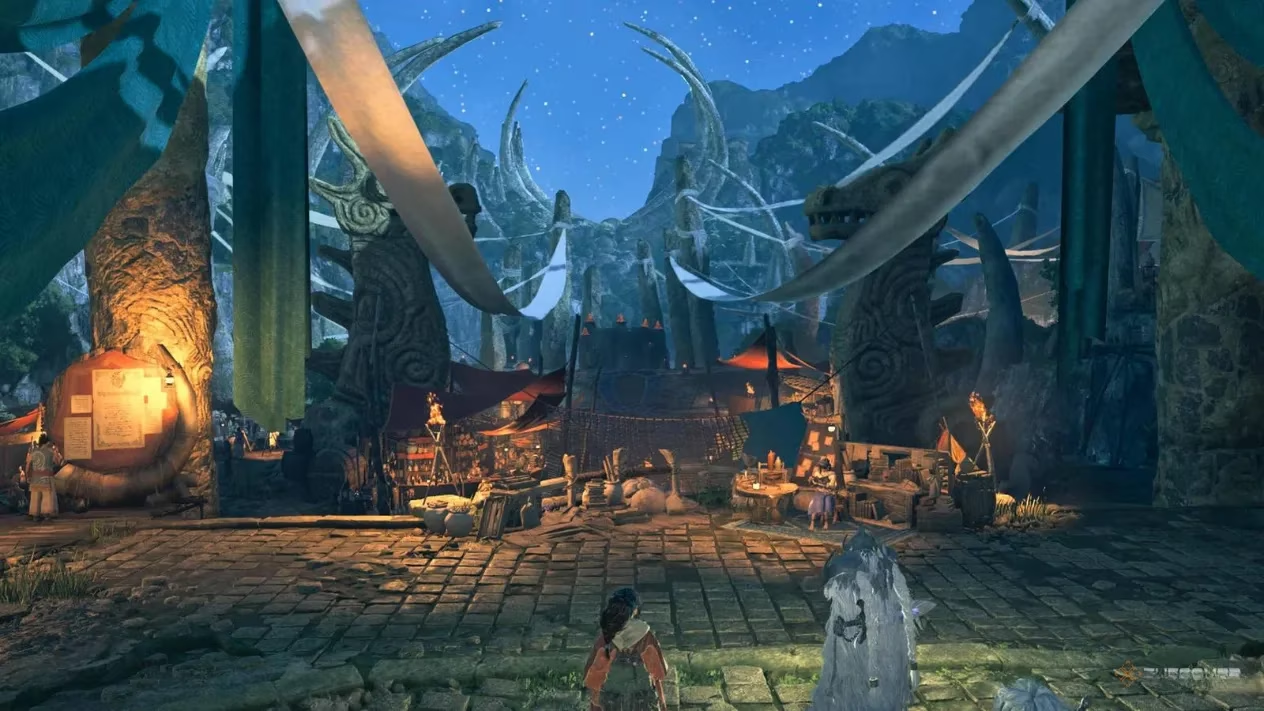
The arena may seem like a straightforward slugfest—just you, maybe a partner, one monster, and walls that won’t let anyone retreat. But don’t be fooled by the absence of tracking paintballs or the blissful lack of a fleeing target. Here, the beast has nothing to do but fight back with every fiber of its enraged code, turning the confined space into a pressure cooker where every missed dodge can spell disaster. It’s like a boxer suddenly thrown into a phone booth with a grizzly bear: the space is tight, the rules are different, and your usual footwork might just trip you up.
🏟️ How to Step Into the Ring
To find these adrenaline-fueled bouts, you won’t need to comb through the wilds or decipher cryptic guild records. Everything starts in the Grand Hub, a bustling social area that arrived alongside Title Update 1 and quickly became the nexus of post-game life. To get there, hunters must venture to Suja and use the Peaks Back Gate. This scenic entrance opens into a mountain-side haven where hunters gather, share meals, and prepare for the next big hunt.
Once inside, the hub’s layout guides you naturally toward its centerpiece: the Arena Quest Counter. There stands Ricardo, a stoic figure whose very presence seems to hum with the energy of a thousand battles. He’s positioned just beside Lotta, the handler for standard quest launches. Speak to Ricardo, and he’ll present a list of arena battles ready to be posted. The interface is simple, but the decision carries weight—once you accept, there’s no stopping to gather honey or craft a max potion. You’re committed.
⚔️ The Rules of Engagement: No Comforts, No Chase
On the surface, an arena quest looks like a dream for any hunter tired of monster marathons. The target is trapped in an enclosed arena, meaning it can’t flee to a different zone to sleep off its wounds or call for reinforcements. Your offensive onslaught can be relentless and uninterrupted—a promise of pure, distilled combat. But Capcom’s designers, ever the tricksters, injected a twist that turns this from a shooting gallery into a masterclass in improvisation.
You won’t be bringing your meticulously crafted, augments-infused, layered-armor masterpieces into this fight. Arena quests strip you of your personal gear and hand you a preset combination of armor and weapon. Think of it as being a world-class guitarist who is suddenly handed a beautifully tuned, but utterly unfamiliar, flamenco guitar backstage at a concert. The fundamentals are the same, but the weight, the balance, the voice of the instrument—it’s all off. Your muscle memory screams for the comfort of your own greatsword, but instead you’re learning the tempo of a lance set or the rhythm of a gunner build. This forced adaptation is the arena’s true challenge, demanding a deep understanding of all fourteen weapon types and the ability to pivot your playstyle on a dime.
That’s not all. Your pouch—the sacred repository of life-saving powders, traps, and flash pods—is also swapped out. The game provides a fixed item loadout for each quest. You’ll only have what the game gives you, which means you can’t rely on your usual stockpile of max potions or ancient healing items. Every ration, every coating, every trap tool is a limited resource you must use wisely. The arena becomes a stage for resource management, where healing at the wrong moment can leave you scrambling against a monster that just won’t let up.
🎯 Types of Arena Challenges in MH Wilds (2026)
Ricardo doesn’t just offer one flavor of combat; he curates a selection of challenges that cater to different appetites for pain and glory. Here’s how the Arena counter breaks down in 2026, reflecting the latest updates:
| Quest Type | Quest Conditions |
|---|---|
| Arena Quests | Maximum of two hunters per quest. Hunters are given specific equipment and item loadouts. Use of Support Hunters is allowed. |
| Free Challenge Quests | Limited-time quests with up to four hunters. Players are allowed to use their own equipment and items. Use of Support Hunters is allowed. |
| Challenge Quests | Limited-time quests with up to two hunters. Hunters are given specific equipment and item loadouts. Use of Support Hunters is allowed. |
-
Arena Quests are the backbone, the classic duels where you and a partner squeeze into the same philosophical straitjacket of preset gear. Support Hunters (NPC allies) are permitted, so solo players can still bring a companion to share aggro.
-
Free Challenge Quests flip the script: here you can strut in with your own meticulously optimized build, and up to four hunters can join the fray. These time-limited events often feature fan-favorite monsters with boosted rewards, making them a fantastic way to flex your perfected gear in a focused environment. It’s like a victory lap where you finally get to show that monster what your real set can do.
-
Challenge Quests are the purest form of the arena ethos—limited-time, two hunters max, and preset loadouts once again. These are the leaderboard chasers\u0026apos; paradise, where every second counts and the global rankings become a battlefield of their own.
💰 Rewards That Forge Legends
Slaying a monster in the arena doesn’t just earn you the usual carve materials (though those still appear); the real treasure lies in the unique arena coins that spill from the corpse. These coins are stamped with the essence of the monster you just conquered—Rathalos Coins, Tigrex Coins, Velocidrome Coins—and they serve as a currency that Gemma, the ever-reliable blacksmith, can use to craft exclusive gear.
Head back to the forge after a successful arena run and you’ll discover entirely new armor sets waiting to be fashioned. These aren’t just reskins; they often come with distinct skills and set bonuses designed to reward arena veterans. Some offer unique combinations of offensive and quality-of-life skills that can’t be found on standard monster gear. The process feels akin to collecting rare medals and exchanging them for a custom-tailored fighting suit—the more coins you earn, the more you can expand your wardrobe with gear that declares, \u0026ldquo;I thrive in the chaos of the cage.\u0026rdquo;
Beyond armor, hunters can also earn pendants. These dangling trinkets attach to your weapons and serve as pure cosmetic flair. Whether it’s a miniature shield, a beast’s icon, or a glowing vial, pendants let you personalize your arsenal and carry a memento of your arena triumphs into every hunt. They\u0026rsquo;re the quiet flex, the subtle signal to others in the Grand Hub that you’ve been through the grinder and emerged with style.
🧠 The Mindset Shift: Thriving Under Pressure
Engaging with the arena system in Monster Hunter Wilds is less about raw muscle memory and more about cultivating a calm, analytical mind when everything you know is stripped away. The preset gear forces you to read the weapon\u0026rsquo;s sharpness gauge, ammo types, or phial mechanics in real time, adapting combos that feel as awkward as writing with your non-dominant hand. Yet, that’s precisely where the magic lies. After a few rounds, you\u0026rsquo;ll find your pattern-recognition sharpening; you start noticing openings you never saw on your main weapon, and you discover a fluidity that comes from understanding the monster\u0026rsquo;s AI in its rawest form, without the crutch of a comfortable setup.
Veterans of the arena often offer this advice: treat each preset loadout like a puzzle. Open your menu, study the skills, the armor resistance, the item pouch layout. If you have sonic bombs and the monster is a burrower, that\u0026rsquo;s your key. If you\u0026rsquo;re given a Hunting Horn with specific songs, memorize the notes before you engage—your buffs could be the difference between a clean time and a triple cart. The arena doesn\u0026rsquo;t forgive ignorance; it rewards preparation.
🔥 Why the Arena Matters in 2026
As Monster Hunter Wilds continues to evolve with updates and expansions in 2026, the arena stands as a pillar of community competition and personal growth. It\u0026rsquo;s a direct nod to the series\u0026rsquo; arcade roots, a place where leaderboard chasers and fashion hunters alike find common ground. Speedrunners dissect every preset to shave milliseconds off their times, while casual players test the waters of unfamiliar weapons without the pressure of building a set from scratch. The Grand Hub buzzes with stories of narrow escapes and flawless runs, and the currency of coins keeps the endgame loop fresh.
So the next time you find yourself weary of chasing a Gypceros across three zones, or you just want to prove that a hunter is more than their equipment, head to the Peaks Back Gate and into Suja. Find Ricardo, accept the loadout you\u0026rsquo;d never craft yourself, and step into the cage. The monster cannot run, but neither can you. In that enclosed space, you\u0026rsquo;ll find not just a battle, but a mirror reflecting your truest hunting instincts. Leave your comfort zone at the door—you won\u0026rsquo;t need it where you\u0026rsquo;re going.