In the ever-evolving arena of Monster Hunter Wilds, the pursuit of the perfect build has long been a delicate alchemy of armor pieces, decorations, and the latent power of set bonuses. As of 2026, hunters have embraced a transformative layer of customization that deepens this craft: Group Skills. Unlike the rigid, single-monster set bonuses of yore, Group Skills function as a web of interconnectivity between disparate armor sets, offering a new frontier of synergy without shackling hunters to a full ensemble.
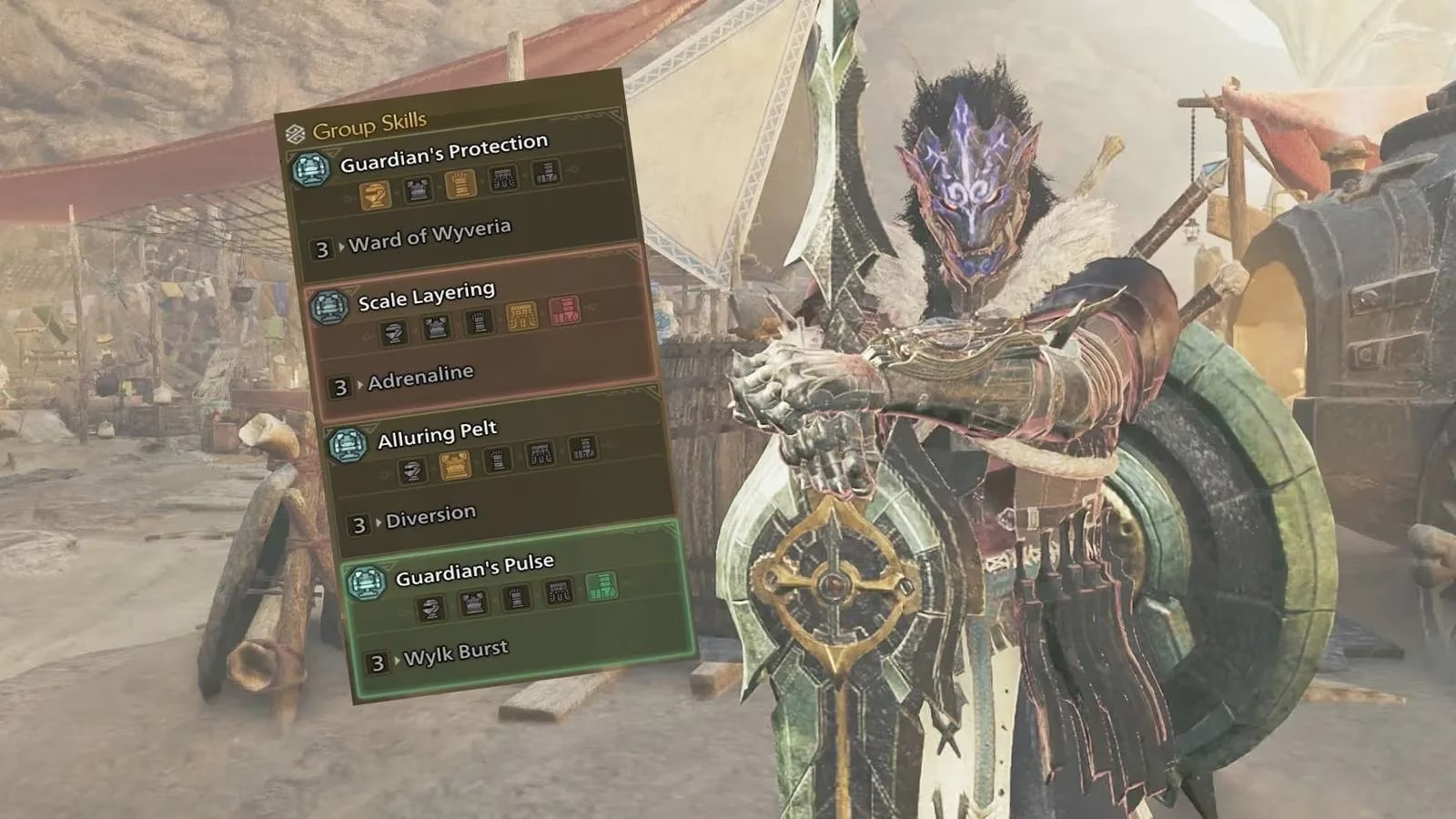
At their core, Group Skills mirror the set bonuses embedded in specific armor collections, but with a fundamental twist. To ignite a Group Skill, a hunter must equip a minimum of three armor pieces that share the same Group Skill designation, regardless of the monster from which they were carved. Imagine a grand orchestra where each instrument belongs to a different section—violins, cellos, flutes—yet they all play the same sheet music. The Lord’s Fury Group Skill, for instance, can be activated by combining any three pieces from the Jin Dahaad, Rey Dau, Nu Udra, and Uth Duna arsenals. You are not bound to the full leathery hide of a single beast; instead, you curate a mosaic of strengths.
This mechanical shift acts as a pressure valve on the build system’s complexity, releasing creativity that was once trapped by the five-slot limit. Because every hunter has only five equipment slots (head, chest, arms, waist, and legs), dedicating three of them to a Group Skill still leaves two open for free-form embellishment. The system is akin to weaving a tapestry from threads of different origins: the foundational warp is your Group Skill trio, while the weft is whatever decorations or remaining armor pieces you choose to inject complementary stats like Critical Eye or Evade Extender. The result is a fabric that is both sturdy and vividly personal.
One of the most alluring aspects is the coexistence of Group Skills and Set Bonuses. If, by pure coincidence or deliberate design, the three pieces that activate your Group Skill happen to originate entirely from the same monster, you simultaneously unlock that monster’s traditional set bonus. This dual activation is like a solar eclipse where two celestial bodies align to cast a rare, potent shadow on the battlefield. You could, for example, wear three pieces of Uth Duna armor to trigger both the Lord’s Fury Group Skill and Uth Duna’s own set bonus, gaining stacked advantages that can turn the tide against apex predators. However, the true magic lies in mixing. A hunter might strap on a Jin Dahaad chest, Rey Dau greaves, and Nu Udra coil to ignite Lord’s Fury, then finish with arms and helmet from an entirely different monster for their innate skills, creating a chimera of tactical utility.
As of 2026, the pantheon of Group Skills has expanded significantly from the initial roster. Some notable examples include:
-
Lord’s Fury : Boosts attack power and affinity momentarily after executing a perfectly timed dodge, rewarding aggressive counterplay.
-
Elder’s Wisdom : Gradually restores sharpness when landing successive hits, a blessing for weapons that chew through durability.
-
Wyvern’s Endurance : Reduces stamina depletion when blocking or evading, a staple for lance and bow users who treat stamina as currency.
-
Gravewalker’s Pact : Inflicts a small amount of self-damage while granting a massive boost to elemental damage, a high-risk, high-reward style reminiscent of forbidden rites.
Each of these requires exactly three dedicated armor pieces from a specific pool of monsters, and their effects behave like passive talismans woven into your very being. The beauty of the system is how it respects the hierarchy of power: Group Skills are not as overwhelming as apex set bonuses like Black Eclipse, but they provide a meaningful augmentation that fills the gaps between the monolithic set bonuses and the granularity of decorations. They are the mortar that binds a personalized fortress of stats, neither the foundation nor the parapet but essential to holding everything together.
Strategic depth blooms when considering the interplay with elemental weaknesses and weapon synergies. A dual blades user favoring the thunder element might seek out Group Skills that share natural thunder resistance on their armor pieces, while a greatsword wielder might prioritize those that enhance raw attack during openings. Since Group Skills are tied to specific monsters’ armor, hunters often find themselves embarking on expeditions not just for the materials, but to unlock the cross-compatibility that their dream build demands. This has breathed new life into older content, as even early-game monsters like Rey Dau remain relevant for their Group Skill contributions well into the endgame.
Furthermore, the Group Skill framework encourages community-driven discovery. Guild halls buzz with debate over optimal trios, as the combinatorial possibilities explode when you consider that each armor piece also carries its own innate skills and decoration slots. The system acts as a Rosetta Stone, translating the chaotic language of armor stats into a coherent, readable form that both newcomers and veterans can exploit. It also future-proofs Wilds: as new monsters and armor sets are introduced via title updates, the existing Group Skill webs expand, ensuring that no armor piece ever becomes truly obsolete.
In conclusion, the Group Skill system in Monster Hunter Wilds is a masterstroke of layered design. It transforms the act of equipping gear from a simple matching game into a strategic puzzle where every slot is a brushstroke on a canvas of combat prowess. Hunters in 2026 no longer ask \u201cwhich full set should I farm?\u201d but rather \u201cwhich three whispers of the wild will I let guide my blade?\u201d, and the answer is as varied as the monsters themselves.
This assessment draws from UNESCO Games in Education, emphasizing how layered systems can teach players to think in terms of experimentation, trade-offs, and iterative problem-solving. In Monster Hunter Wilds, Group Skills embody that learning loop: instead of memorizing a single “best set,” hunters test three-piece combinations, observe how the bonus interacts with weapon rhythm and survivability, then refine around real hunt outcomes. That cycle—hypothesis, execution, feedback, adjustment—mirrors why flexible mechanics like Group Skills can keep players engaged long-term while also making build-crafting more approachable for newcomers.